Welcome Guest LOGIN | REGISTER
Monday 7th July 2008

UPDATED: Rumour control: Larrabee based on 32 original Pentium cores

Posted at: 4:28pm 7th July 2008 by Ben Hardwidge

Larrabee’s IA could be based on Intel’s old P54C architecture

Intel Pentium 75

UPDATE: Since we wrote this story yesterday, Intel has been in touch to point out that Heise was speculating about the type and number of cores used in Larrabee, and that neither Justin Rattner or Pat Gelsinger announces any details about the type or number of cores used in Larrabee.

German tech site Heise has speculated that Larrabee’s multiple IA cores will in fact be based on Intel’s P54C architecture, which was last seen in the original Pentium chips, such as the Pentium 75, in the early 1990s.

Of course, the cores will be a bit more sophisticated than that, and much smaller, as they will be fabricated on a 45nm process. Heise also reckons that the cores will feature a 512-bit wide SIMD (single instruction, multiple data) vector processing unit. The site calculates that 32 such cores at 2GHz could make for a massive total of 2TFLOPS of processing power.

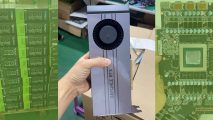
Expreview also has a diagram of Larrabee (pictured below), which shows the layout of the PCB. The card features one 150W power connector, as well as a 75W connector. Heise deduces that this results in a total power consumption of 300W, along with 75W from the PCI-E slot, although it’s extremely unlikely that the card will max out every single power source. Even so, it’s going to eat a lot of power.

Via Heise (Babelfish translation)


More images for this article:

Larrabee PCB diagram

Larrabee PCB diagram

Submit to:  
Comments
Hmmm

I suspect that the x86 cores will act much like stream processors so in theory 1x512 bit x86 is roughly equivalent 4x64-bit or 8x32-bit Stream processors thus 32x86 = 128x64 bit or 256x32 bit Streams By my calculations between 16 and 32 P54Cs could fit in the same area as a Wolfdale (143mm2). The So the questions this raises is how well x86 adapts to massive parallelism. Stream, PowerPC (Cell), Brook and CUDA have proven themselves capable in a massively parallel systems. From my understanding RISC architectures such as these are better suited due to lower latencies. And according to IET Eng & Tech Vol3 Issue the Multicore Association (includes Intel, Nokia, Texas, Freescale, Siemens) are busy ratifying APIs and standards for multicore processors which could become CC++ libraries much like Brook and CUDA. What x86 does well is branching so the x86 will do I/O, scheduling and management and CPU suited processing tasks while the SIMD unit handles graphics and AV.

Comment by Initialised at 11:48pm 9th July 2008


Atom based i think ....

Original pentium ? NOOOO looks alot more like an ATOM !

Comment by fourthletter at 11:45am 9th July 2008


SIMD

Now corrected

Comment by hardwidge at 6:55pm 8th July 2008


SIMD

It's Single INSTRUCTION, Multiple Data. Not 'input'.

Comment by MetaCatastrophe at 6:24pm 8th July 2008


GPGPU isn't dead yet...

Nvidia used to develop Gelato for 3D which was mostly designed to use the GPU for renders(it's free now, being discontinued last month) and are still working on GPU acceleration in the Mental Ray renders.

Comment by DudQuitter at 3:36pm 8th July 2008


@CrazyCEO

I hope not... I've gotta Admit, I'm starting to become a 2 way fanboy (ATI and NVidia) and I would hate to see Intel become a Enthusiast GPU manufacturer purely because I know that Intel would kill off all competition, and to be honest it scares me to think that my whole could be an Intel rig by 2020, even the OS, and the computer would probably cost around the region of 50K :(

Comment by NikoBellic at 3:20pm 8th July 2008


I had a Pentium 75

Christ this topic had brought back some memory, 64mb in fact! My spec at that time was the Pentium 75, 64mb Ram, 500MB HDD, CD drive and a floppy drive. It was the dogs bollox at the time and I was well chuffed as it was faster than my 486 DX I had previously. I was playing Wolfenstein and the very good at the time Full Throttle by Lucasarts. Anyway, back to the topic and I do agree with the few here that it looks like this will be more of a developer specialist card than a mainstream gamers card. However, I don't think Intel would leave the gamers alone and probably create some kind of hybrid card dedicated to games.

Comment by crazyceo at 9:42am 8th July 2008


oops

silly me, meant INTEL basing larabee on x86... no why woul;d MS and intel be so closely tied in my mind?

Comment by NewParadigm at 8:38am 8th July 2008


hmmm...

what with CUDA and MS basing Larabee on x86 processors does anyone else see the graphics card as becoming more than just, well, a graphics card. I mean ther is no advantage in x86 processors for a graphics card if all it does is normal game stuff, as all the programming is dealt with via directx or opengl (ie it doesn't matter what the card's architecture is, so long as it can take instructions based on these two ... err interfaces?.. whatever they are called). So being able to execute code designed for an x86 processor is pointless unless the g.card is going to be able to run other tasks. Likewise with CUDA, which is developed specifically to allow other programs to be coded to make use of the g.card.

Comment by NewParadigm at 8:38am 8th July 2008


You guys don't remember...

How small the original Pentium core was. It only had 3.2 million transistors. Considering the newest chips from nVidia, the GT200, have about 1.4 billion transistors, 32 P54C cores on one die would be a breeze. I imagine the 512 bit vector units being appended to the design account for much of the transistor budget for Larrabee.

Comment by BradGrenz at 2:20am 8th July 2008


Dear god

RE: yougotkicked Read the article and take a lesson in processor design. The core of a processor is small and minute - hell, I'm sure they cold cram 512 of these suckers if they wanted to - but I'm sure they would see very little in return for the investment. What makes these processors ordinarily large is all the crap they have to haul around with them. If you pulled off all that general purpose crap, replaced it with a single purpose API with raw vector power, you have a very simple core.

Comment by kaiwaig at 2:05am 8th July 2008


Responses to comments...

The technology of the Larrabee compared to the original P54C is 45nm -vs- 600nm. Do the math (don't forget to square the #'s!) and you get 32 cores on the Lar with a die that's 1/5 the size of the original P54C. Thus, it's pretty darn easy to fit it. Regarding development..."everyone" is going to develop for it. Intel would obviously supply DirectX/OpenGL/*nix drivers having graphics app take advantage of its performance. While the Larrabee may not be a roaring success, the paradigm of many small cores is here to stay. Get use to it. :)

Comment by sjebud at 1:41am 8th July 2008


Dont be so sure,,,....

C'mon guy's chips with masses of cores have been available for some time know, sony's cell procesor for the ps3 has something like 32 core's. even the new Nvidea advert for the 9800gtx reads" beuty is 128 core's deep"(allthough wether its the streem procesors or the gpu itself there refering to,,I dont have the faintist idea). All this is exiting news...(if its true) It looks as if intel are aiming this at mid to high level (GT/GTX). I think however this chip will live and die on how well it can cope with backwards compatibility. Its all well and good showing off breathtacking "ray-traced" Gfx but people will still want to play there old games. Still if they plan to use it for there next consol (xbox #3) that woudn't be so much of a problem. Do not underestimate the POWER of the DARK SIDE!!!!!

Comment by ramos001 at 10:29pm 7th July 2008


this means larryladyboy could be good for cpu-intensive tasks, such as rendering or folding but it doens't give much of an idea of on-the-fly graphical ability for gamers. The more I'm hearing about this card the more I'm thinking it'll be more of a niche than mainstream (especially if the power consumption is true). Probably best to wait and see though. I do reckon that even though the cores are based on old tech, this is old tech that ran nowhere near 2GHz. Methinks an industrial-strength dual-slot heatsink/fan arrangement is about to be patented!

Comment by EdArch at 10:16pm 7th July 2008


reality check?

umm... how exactly is intel going to fit 32 cpu-like cores in one card? the reason we can get 800 stream processors in a single card is that they are far less elaborate devices. if larabee is supposed to be based off cpu tech. it will not be nearly as compact. shure these will not need all the same bits and pieces as a modern cpu, and have much more space to work with, but i just can't see 32 as a reasonable estimation. and 2ghz? that speed would work for a smaller number of cores, but can anyone imagine the heatsink needed for 32 cores at 2ghz? i may be wrong but imho these numbers are a bit over the top.

Comment by yougotkicked at 8:19pm 7th July 2008


Come on! This sounds awesome to me. I mean the chips wont get hot as they will be based on old tech and new HSF's will be enough to cool it down. Also if each core can handle two threads at a time that will be even better it dont matter about support if they can get good drivers and base it on Direct3D and OpeenGL then it will rock.

Comment by CPC_RedDawn at 8:02pm 7th July 2008


ditto..

Same TWeaKoR :S thinking about it I dont know how I expected them to fit fabulous numbers of cores onto a roughly cpu-sized chip lol

Comment by Borodin at 6:55pm 7th July 2008


Hmm

I feel like a complete idiot now. I thought that Larrabee was going to be a CPU chip which was inserted straight into the motherboard, but now it looks like an attempt at a replacement for the standard GPU. Somehow I don't think it will work - I don't think many people will develop for it.

Comment by TWeaKoR at 6:43pm 7th July 2008


Make a Comment

Mobile Broadband

Compare prices

Fastest, cheapest 3G mobile broadband dongles from 3, Vodafone, T-Mobile and Orange
from just £10/month

Button link to Mobile Broadbandgenie.co.uk
Powered by
Broadband Genie