WinFast PxVC1100 features Toshiba’s SpursEngine for HD video transcoding that’s faster than real-time
After developing a brand new CPU architecture from the ground-up, you’d expect that Toshiba, Sony and IBM would have more uses for the Cell architecture than the PlayStation 3, and Toshiba has been quick to make use of the architecture’s HD video transcoding abilities in its new Qosimo laptops. However, Leadtek is now taking Toshiba’s efforts a step further by putting the chip onto a PCI-E card for desktop PCs.
The WinFast PxVC1100 is based on Toshiba’s Toshiba’s SpursEngine SE1000 processor, which is a cut-down version of the Cell chip. The SpursEngine chip features four SPEs (synergistic processing elements) based on 128-bit RISC cores, along with H.264 and MPEG-2 codecs, but it doesn’t contain its own CPU as the chip in the PS3 does. The chip is capable of encoding and decoding H.264, MPEG-2 and MPEG-4 video streams in hardware.
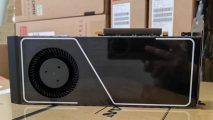
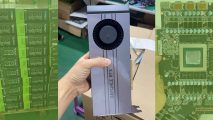
Leadtek’s low-profile card also comes with 128MB of 1.6GHz XDR memory, and has a one-slot cooler. According to Leadtek, the card can be installed in 1x and 4x PCI-E slots, and it also requires external power from a four-pin floppy drive power connector. The company hasn’t revealed the clock speed of the SpursEngine chip on the card, although the SPEs in Toshiba’s SpursEngine-equipped laptops run at 1.5GHz. Leadtek says that the card will enable both encoding and transcoding at speeds that are ‘faster than real-time.’
Leadtek is currently demonstrating the card at CEATEC (Cutting Edge IT & Electronics Comprehensive Exhibition) in Japan, and says that it plans to ‘make a splendid speech about its outstanding development’ tomorrow. No release date has been revealed yet, but we’re told that the software bundle will include Corel’s WinDVD and DVD MovieFactory.
People.. This thing encodes and transcodes, very well too. Decoding a 1080p24 video is one thing, when it comes to encoding, no cpu available or can do that in realtime, let alone faster than real time, it usually takes 4 - 6 times as long as the playtime of a video, especially when there are effects applied from a program like adobe PE7, even on my i7 12GB ddr3 SSD CF-X beastly comp it renders slower than real time. besides why would anyone need faster than real time decoding?? to get every frame rendered while fast-forwarding?? One thing is true though, as soon as OpenCL cathes on with Win7 and Snow Leopard from apple, GPU's will be able to outperform this, especially with the ATI 4870's 800 cpu cores.
Is that the same SPE found here? playstation 3 secrets: http://www.edepot.com/playstation3.html
With the advent of CUDA and other similar APIs you have the general ability to write highly paralel code and target a number of platforms. Cell could fit into this to boost all manner of applications. We are already breaking the x86 cage with uses for GPUs to do other work (Folding for example, which already runs on Cell in PS3). Of course Intel fight back hard with Larabee to maintain x86 dominance/compatibility in this emerging hardware landscape. Interesting times, as ever.
Like one of the other posters said, with six and eight core cpus in the pipeline, six and eight core hybrids that include one or two on board gpus, the same will happen with this cell board as happened with MPEG-2: A couple of years ago cpus couldn't decode/play MPEG-2 streams without a help of hardware decoding graphics card. Now Core2Duo, Core2Quad, AMDX2's, Phenoms don't even work up a sweat decoding/playing MPEG2. 6 core cpus are due out this year and 6 core consumer versions due out early next year along with some 8 core cpus as well...along with die shrinks enabling faster clock speeds, more on-board cache, this cell board looks like it's doa. Especially with dirt cheap graphics boards being able to decode 1080i/p now, what exactly are we supposed to get excited over with this board? It's only chance is if they release the firmware, open up all the code and documentation so that it gains a fast following for Linux/MythTV users. That and a much lower price may allow this and similar boards to survive for a while in the marketplace, until 8 and more core cpus hit mainstream or at least the enthusiast level of sales. Too little, too late, at too high a price.
If the cost is less than £80 and it runs cool and -importantly- quiet, this could be fantastic for HTPC builders... So long a the software support is there. At nearly $400 though, surely it's not even worth considering over an HD accelerating, passive cooled £100-£150 GPU?! It seems to be offering far more power than nessessary too, unless you like watching blu rays in fast forward, and someone needs a slap for deciding to power it off a damn floppy disk power connector!
Its a nice idea, but isn't it a little late to the party? With Cyberlink PowerDirector 7 apparently introducing CUDA support by the end of the year, plus support for the ATI 4800's as well (http://www.cyberlink.com/eng/press_room/view_1756.html), who's going to buy a separate card for $300 when our GPU's will do the same job!?
I read on tomshardware.co.uk that this will be coming in at nearly $300! Surely you'd do better getting a cheap graphics card such as the new 4350 or 4550? The only people who will find this usefull will be people who do a lot of encoding surely? http://www.tomshardware.co.uk/toshiba-video-addon-spursengine,news-29294.html
128 bit register RISC CPU? Multiple cores of that CPU? Sounds yummy. Question: "Why aren't these Cells powering servers and workstations?" Answer: "Monopoly." These CPU's should be in home and business computers all over the world. It is the prison of the x86 instruction set and the monotheistic religion of Microsoft OSes that has us boot in 16 bit mode to this very day and then switch to 32 or 64 bit mode once we are past the bootloader. Why do we do that? Tradition! Tradition is for beer making and classical music. This is technology and innovation is the currency of the land. Intel's x86 line is stale. This Cell, however, tastes great! More Cell processors please!
You could use this card as a x264 decoder in an HTPC setup. For example, my current HTPC is running an nForce board with onboard nVidia graphics, a core2 quad, 4GB memory, no PCI-Express video card. It decodes 720p and 1080p fine. Using an addon card like this, one could potentially spend less on all the rest of the parts, and not need a core2 chip or so much ram, and still not need a dedicated video card. If its fast enough, old cpus could handle HD streams well enough for playback, reducing the overall cost of a workable htpc unit. That's my thinking, probably flawed some how.
If the price is right but it's not for me either way.
http://www.mc.com/microsites/cell/productdetails.aspx?id=2590
Sony, Toshiba & IBM need more than this to give the Cell a new lease of life. How about a 128 SPE GPGPU to rival the upcoming Intel part?
That's an idea, but it's gonna have to cheaper than ati's latest cheapo range (4350-4670), all of which offer similar video playback features and in some cases the ability to game at 720p resolutions (dependent on CPU etc). I know I'm looking at getting a 4670 for my media box, so I can play a few "consoley" titles without having to buy a console.
Would love to see price/performance comparisons between this & standard graphics cards for HD video encoding when it becomes available. While maybe a more specialised market, I don't see this as a gimmick if it performs well and the price is right - not everyone is interested in paying £200+ for a graphics card, (or in playing games at all for that matter...).
This could be a test bed for the PS4. Using Cell Processors for as GPU. This WAS the original plan for the PS3 but went horribly wrong.
GPU accelerated physics, HD video, GPGPU. quad core CPU's and 8 cores in the pipeline. so what will this card actually do that current general purpose hardware cannot already do easily and efficiently? i suppose you might be able to use it for folding hmmmmmm..........?
If you had onboard graphics that weren't too good for DVD playback. This would help? As long as it's cheaper than the cheapest compatible graphics card then they may just sell. Maybe a use in a Media Centre.
will enable us to do this It'll probably only sell to industry and then be replaced by cuda powered apps
u guys rember those physx cards? kind of looks the same as this one.. in the sense that they just seem to be a fad with no real use or software support? correct me if im wrong
Sorry, Custom PC comments are now closed.
Fastest, cheapest 3G mobile broadband dongles from 3, Vodafone, T-Mobile and Orange
from just £10/month